

Where our (technical) articles have a very rigorous tone, this article is specifically intended to give a short, gentle and accessible introduction to Model Thinking by answering 6 important questions.
However, some concepts can only be truly understood through firsthand experience. You can for example explain the benefits of swimming, but to truly grasp its joy, one must get in the water. We believe the same is true for Model Thinking: its full depth and power are only revealed when you engage with it directly.
1. What is Model Thinking?
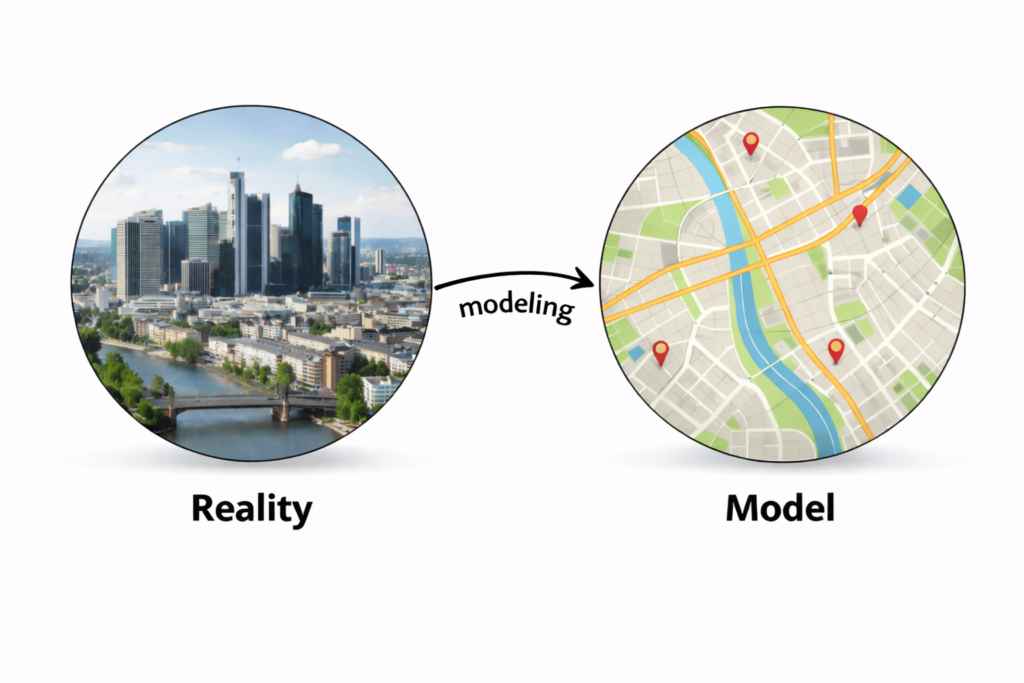
Model Thinking is a disciplined and structured way of thinking that consciously uses models to help us understand and navigate reality, rather than relying only on our default, intuitive way of thinking. While Model Thinking represents a deep philosophy, the core idea is simple: we capture reality in a simplified representation—a model—that helps us make sense of complex situations. It is like the difference between simply trying to find your way in an unfamiliar city vs using a conscious and structured approach that gives you much greater understanding and control, like a (mental) map. Now ask yourself: which approach is more likely to get you to your destination successfully and quickly?
Importantly, models are not static. They are continuously updated and refined as we gain new knowledge and experience! Model Thinking therefore also offers a structured approach to learning, growth, and self-development.
- Learn proven tools, concepts, and techniques that deliver value in real-world situations.
- Understand complex situations more quickly and accurately.
- Make better judgments, predictions, and decisions.
- Continuously improve by comparing what we expect with what actually happens.
3. What are examples of models?
Models appear everywhere in our daily lives, we have given some examples in the table below:
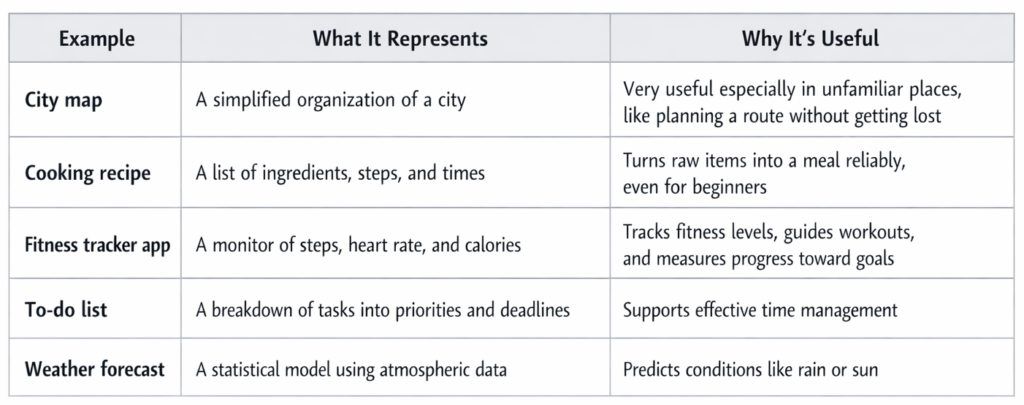
So when we look closely, we find out we already heavily make use of and rely on models that can be quite intuitive even for complex situations. Even AI is essentially a complicated model!
4. Does Model Thinking relate to concepts we might already know?
It’s always worth asking if a new concept relates to concepts we already know under different names. Model Thinking could, for example, also be described as Scientific Thinking, as science is built on creating models with structures and assumptions that are updated with experimental evidence.
The scientific method also needs to be refined and disciplined as it deals with complexity. Likewise, as science creates technologies, our experience-based models are a form of technological development—they solve problems we once struggled with.
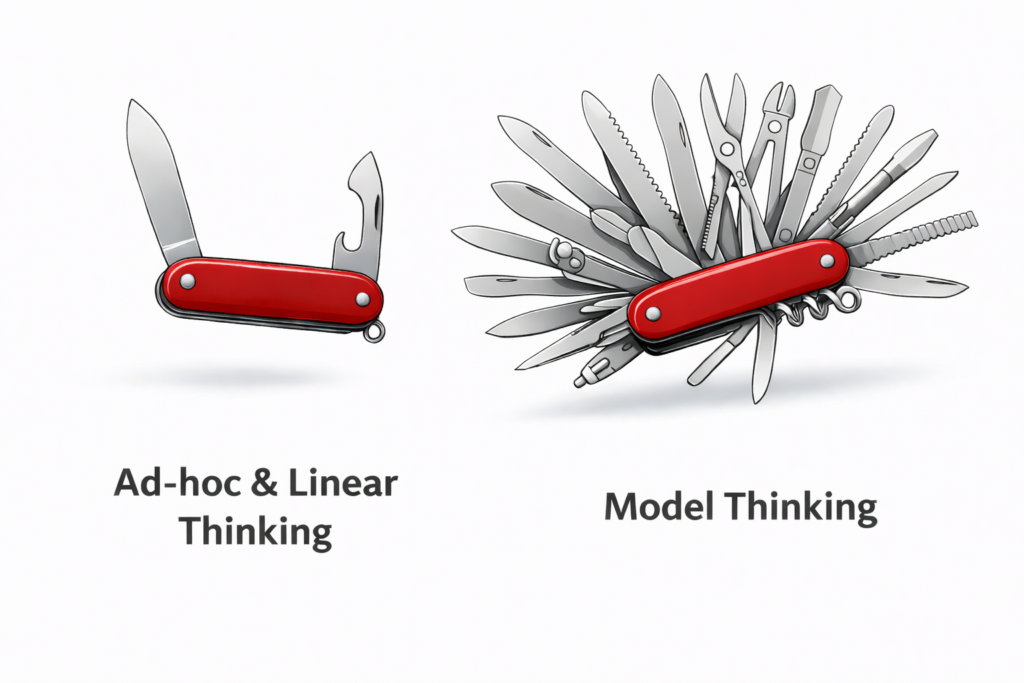
This question provides a key practical example of what Model Thinking means. Let’s look at different levels: