
Introduction to Model Thinking: 6 Questions and Answers

Where our (technical) articles have a very rigorous tone, this article is specifically intended to give a short, gentle and accessible introduction to Model Thinking by answering 6 important questions.

However, some concepts can only be truly understood through firsthand experience. You can for example explain the benefits of swimming, but to truly grasp its joy, one must get in the water. We believe the same is true for Model Thinking: its full depth and power are only revealed when you engage with it directly.


1. What is Model Thinking?

2. Why are models so useful and what are the benefits of Model Thinking
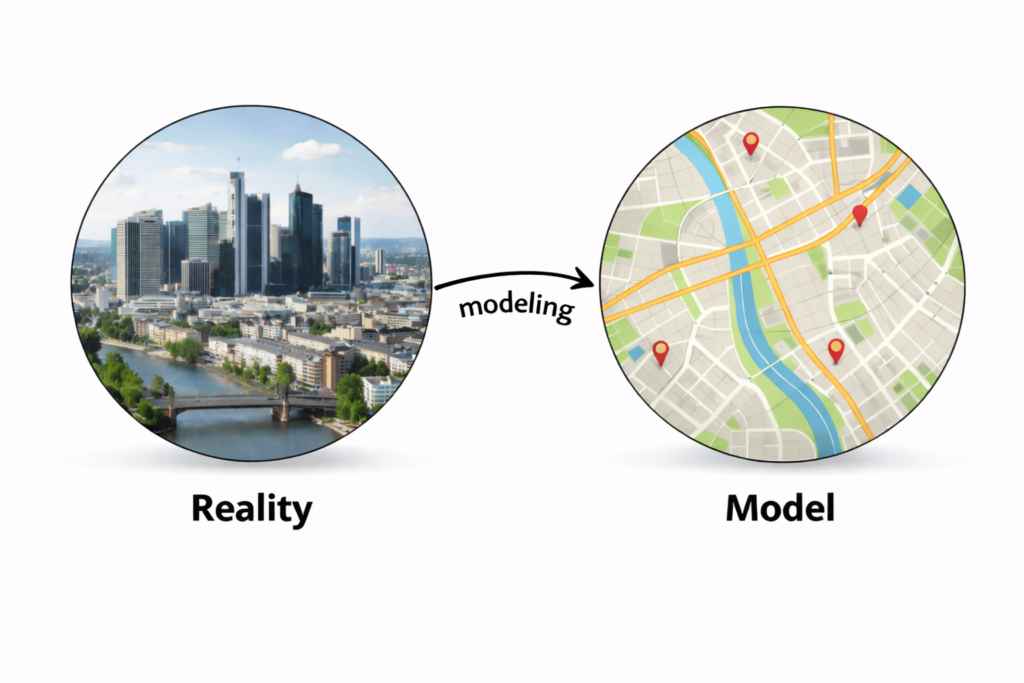
In many cases, reality is simply too complex to understand directly. We therefore use simplified representations to make sense of it. Language is a simple example: the word “chair” represents a mental model that allows us to recognize many different objects as chairs, despite their differences.
From this simple example, we can see that we naturally rely on simplified models to make sense of reality, often without even realizing it. As complexity increases, these models become essential for managing complexity and making sense of the world around us. Model Thinking provides a more deliberate and structured way of developing and using such models.
The benefits are numerous:
  • Learn proven tools, concepts, and techniques that deliver value in real-world situations.
  • Understand complex situations more quickly and accurately.
  • Make better judgments, predictions, and decisions.
  • Continuously improve by comparing what we expect with what actually happens.
 
This is why models are central to decision-making in many leading corporations. On a personal level, we probably all know people whose thinking seems much clearer and more structured. Often, what sets them apart is their ability to build and use mental models that help them connect seemingly separate elements, see the bigger picture, and navigate complexity with greater ease.
 

3. What are examples of models?

Models appear everywhere in our daily lives, we have given some examples in the table below:
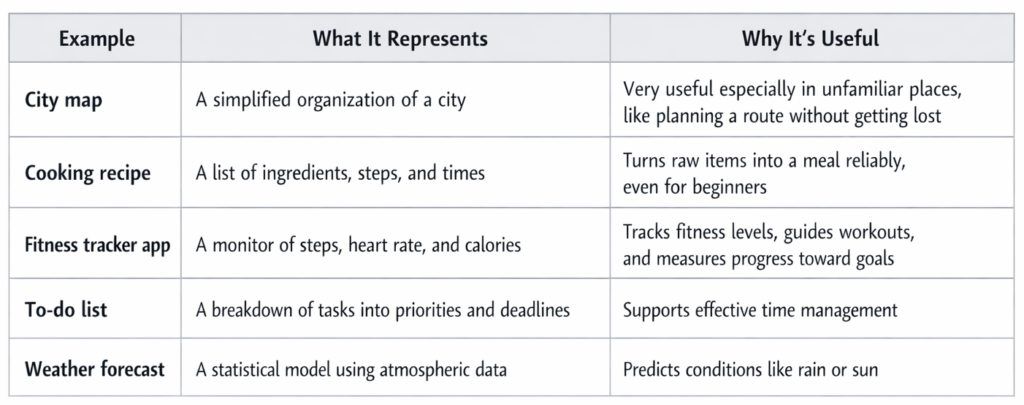
So when we look closely, we find out we already heavily make use of and rely on models that can be quite intuitive even for complex situations. Even AI is essentially a complicated model!

4. Does Model Thinking relate to concepts we might already know?

It’s always worth asking if a new concept relates to concepts we already know under different names. Model Thinking could, for example, also be described as Scientific Thinking, as science is built on creating models with structures and assumptions that are updated with experimental evidence.

The scientific method also needs to be refined and disciplined as it deals with complexity. Likewise, as science creates technologies, our experience-based models are a form of technological development—they solve problems we once struggled with.
5. How does Model Thinking help deal with challenges faced within organizations?

This question provides a key practical example of what Model Thinking means. Let’s look at different levels:


 

Team Level
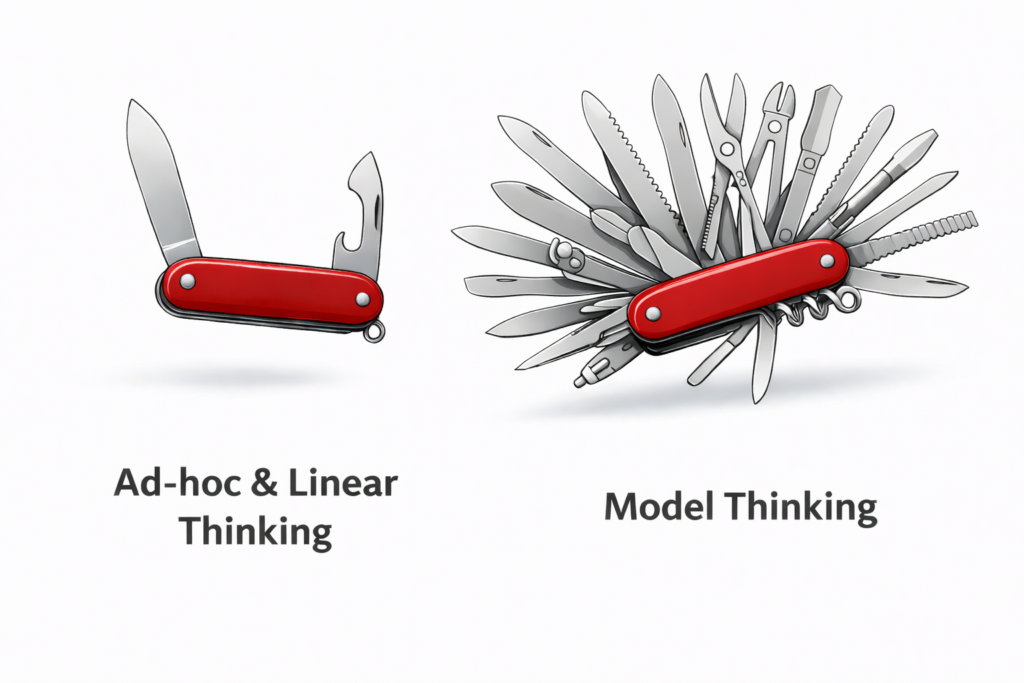
Knowingly or unknowingly, managers are in search of (organizational) models that lead to better performance and cohesion. This is not so different from a football coach looking for the best formation and starting line-up. Without a clear way of thinking about how an organization should be designed and how its different parts should work together, managers tend to operate more ad hoc, making decisions based on what feels right rather than on a full understanding of the relevant factors. As a result, complexity becomes harder to manage, outcomes become more dependent on luck and favourable circumstances, and performance can suffer. This also helps explain why, when the environment becomes more difficult, many managers are exposed and eventually replaced.
 
Individual Level
At the individual level, we also naturally rely on ad-hoc models in the form of beliefs. These beliefs are often too simplistic—for example, that hard work is always rewarded or that, in an organizational context, only rational considerations matter. As these beliefs are often unrealistic, they can misguide our judgment and actions, leading to frustration and harming well-being. This is one of the reasons people seek corporate training in the first place.
Success within organizations starts with updating our models of the context we operate in. Organizations are complex and political environments, where factors such as corporate connections, likability, and appearance can sometimes matter as much as, or even more than, pure performance. Navigating such an environment requires smart tactics, patience, and an understanding of how decisions are made, what drives people, and what incentives and interests shape the organization. Taken together, these forces largely determine the direction in which the organization moves.
It is therefore unfortunate that most training programs overlook these core considerations and, as a result, offer limited value.
 
Corporate Level
A company, like any other complex system, tends to settle into an equilibrium—a certain way of operating and thinking that becomes the accepted norm. Breaking out of this equilibrium and moving to a higher level of performance (‘Higher Rationality’) requires deeper insight and superior models.
 
6. Could I also follow this course elsewhere?
The Model Thinking framework we teach is our own methodology, built on proven insights from the academic and corporate world and enriched through our own models, methods, and teaching approach.
While it draws on established knowledge, the way these ideas have been brought together and developed into a coherent and practical framework is uniquely our own. This combination of content, methodology, and delivery is what makes the course special.
 
Overall Summary
Model Thinking offers a more sophisticated and realistic way of understanding the world—one that is rooted in the use of models. Models are simplified representations of reality that help us make sense of complexity and are continuously updated based on new experiences and information. In fact, we already rely on models in our daily lives, and as the complexity of our environment and decisions increases, so does our need for more advanced model use. Just as more complex problems require more advanced technology to address them, more complex environments require more advanced models to understand and navigate them. This is why successful large corporations and their leaders are, in essence, Model Thinkers. Even artificial intelligence itself is a complex model.
Within corporate environments, we also operate within organizational models. Improving performance—whether at the individual, team, or company level—requires a good understanding of these models and how to operate within them, and eventually how to transition to better models with greater alignment to elevate performance.
Model Thinking, as we teach it, represents a distinct and proprietary framework that embodies this way of reasoning and applies it in a structured, practical manner.
 
Additional
You can find a more extensive introduction here.
Also see our promo below:
Share the Post:
Scroll to Top